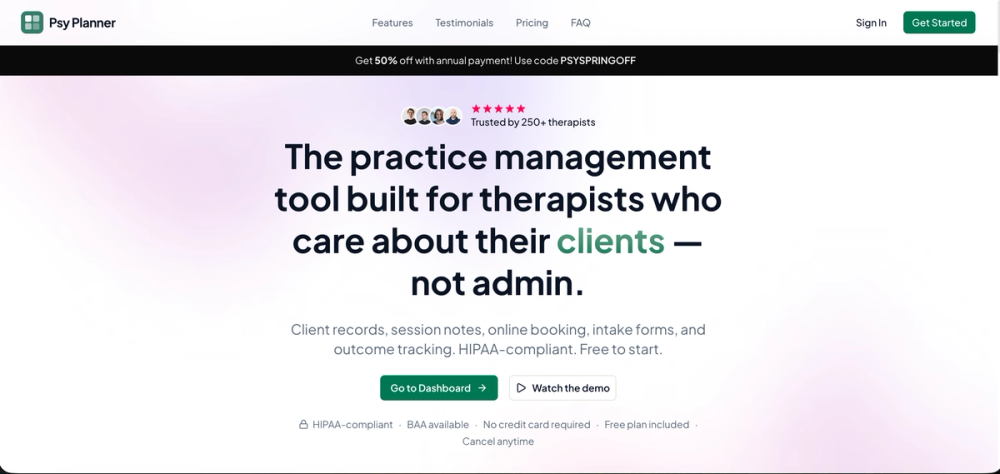
Psy Planner is practice management software for therapists and psychologists, with public messaging focused on client records, session notes, intake forms, scheduling, online booking, and outcome tracking. The product appears designed for mental health professionals who want one connected workspace instead of switching between separate tools for appointments, notes, and client administration.
The clearest value on the Psy Planner site is consolidation. It presents a therapist-focused system that supports day-to-day practice operations while keeping pricing and access relatively straightforward for solo or small-practice evaluators.
Key Features Client records, session notes, intake forms, and scheduling presented as connected parts of one workspace. Online booking that allows clients to book appointments directly into a Psy Planner calendar. Appointment scheduling for planning, rescheduling, and tracking sessions. Outcome tracking, listed in the public meta description as part of the practice management feature set. HIPAA-compliant storage and BAA availability, according to the public page. A product demo video shown on the homepage, giving prospective users a way to preview the workflow. Free-plan access with an upgrade path for practices that need more capability. Use Cases Psy Planner is most relevant for therapists or psychologists who want to reduce the operational friction around running a practice. The public page emphasizes records, notes, intake forms, and scheduling in one place, which suggests a use case where a clinician wants fewer disconnected admin steps before and after client sessions.
It also appears useful for practices that want clients to take more responsibility for booking appointments. The site says clients can book directly into the Psy Planner calendar, which can help reduce back-and-forth scheduling if the booking rules fit the practice's workflow. Clinicians should still verify how calendar settings, availability controls, reminders, and client-facing booking pages work before adopting it.
A third use case is practice evaluation and progress tracking. Outcome tracking is listed as a feature, but the visible evidence does not explain the available measures, reporting depth, or clinical templates. That makes it a promising area to inspect during a demo rather than a capability to assume in detail.