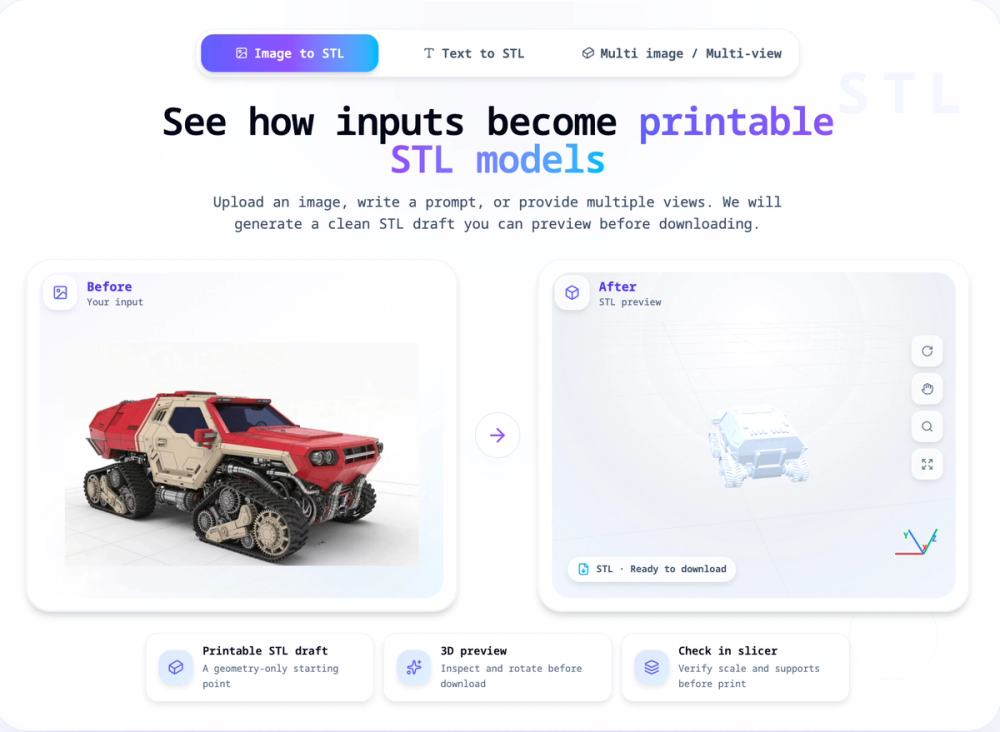
Image to STL Converter is an online AI-powered tool designed to transform 2D images into 3D printable STL models. It supports various image formats including JPG, PNG, JPEG, and WEBP, allowing users to quickly convert their visual ideas into physical objects. The platform emphasizes a streamlined workflow: upload, generate, inspect, and print, making it accessible even for users without extensive 3D modeling or CAD experience.
The core functionality revolves around converting a single image into an STL draft. Users can upload an image up to 8MB and choose from different generation modes: "Fast" for quick shape tests (2 credits, ~30s), "Standard" for most printable drafts (3 credits, ~60s), and "Advanced" for more detailed starting points (4 credits, ~90s). The tool also offers advanced options like PBR Textures, Custom Face Count, and Smart Decimation for finer control over the output.
A key feature is the interactive 3D preview, which allows users to inspect and rotate the generated model in their browser before downloading the STL file. This ensures that the output meets expectations for 3D printing. The platform also supports "Text to 3D" for generating models from descriptions and "Multi image" workflows for subjects requiring more comprehensive shape information from multiple views.
ImageToSTL is particularly useful for creating printable drafts, custom gifts, and prototyping ideas for e-commerce platforms like Etsy. It serves as an excellent starting point for charms, ornaments, reliefs, and keepsakes, enabling makers and designers to quickly test concepts. Educators can also use it for classroom demonstrations to illustrate the transition from 2D images to physical 3D models.
For optimal results, the tool recommends using clear images with a single main subject, visible edges, and a simple background, advising users to crop away clutter and avoid blurry or dark lighting. While the generated STL is a printable draft, users are encouraged to open it in their slicer software (e.g., Cura, PrusaSlicer) to verify scale, manifoldness, wall thickness, orientation, and add necessary supports before actual 3D printing. Credits are automatically returned if a generation task fails, ensuring a fair user experience. The service is built for rapid prototyping and initial geometry creation, not as a full 3D modeling suite, and integrates Tencent Hunyuan 3D technology for its AI generation capabilities.