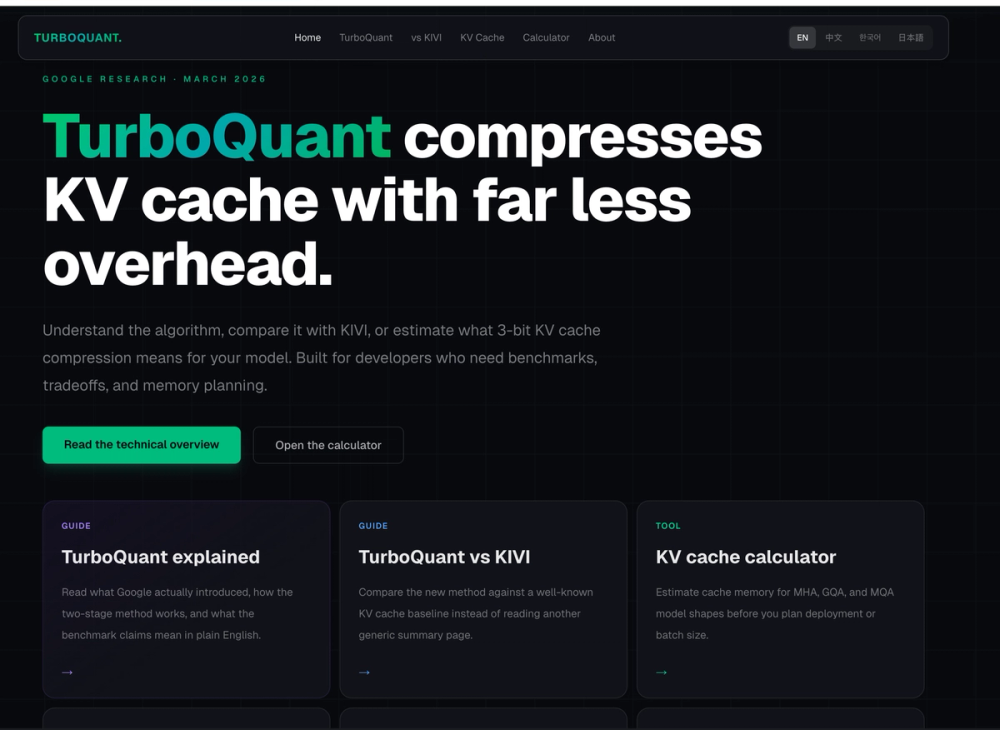
Google TurboQuant Explained — Algorithm, Benchmarks & Tools What is TurboQuant? Google Research's KV cache compression method using PolarQuant + QJL. Benchmarks, memory calculator, KIVI comparison, and deployment guide. TurboQuant,Google TurboQuant,turbo quant,turbo quant Google,KV cache,KV cache calculator,LLM memory calculator,vector quantization,LLM inference optimization,KV cache compression,PolarQuant,KIVI,TurboQuant paper,TurboQuant vLLM,TurboQuant llama.cpp,TurboQuant Ollama,TurboQuant LM Studio Explore the algorithm, review benchmark claims from arXiv 2504.19874, compare with KIVI, or estimate what 3-bit KV cache compression means for your GPU memory. TurboQuant works on any CUDA-capable GPU. The 8× attention speedup benchmark was measured on NVIDIA H100 in 4-bit mode. Consumer GPUs like RTX 4090 also benefit from the memory reduction. At ~3.5 bits per channel, TurboQuant matches FP16 quality on all tested benchmarks (LongBench, Needle-in-a-Haystack, RULER). Below ~2.5 bits, measurable accuracy loss begins. The '3-bit zero-loss' headline simplifies a continuous precision tradeoff.
Newsletter
Join the Community
Subscribe to our newsletter for the latest news and updates