Overview
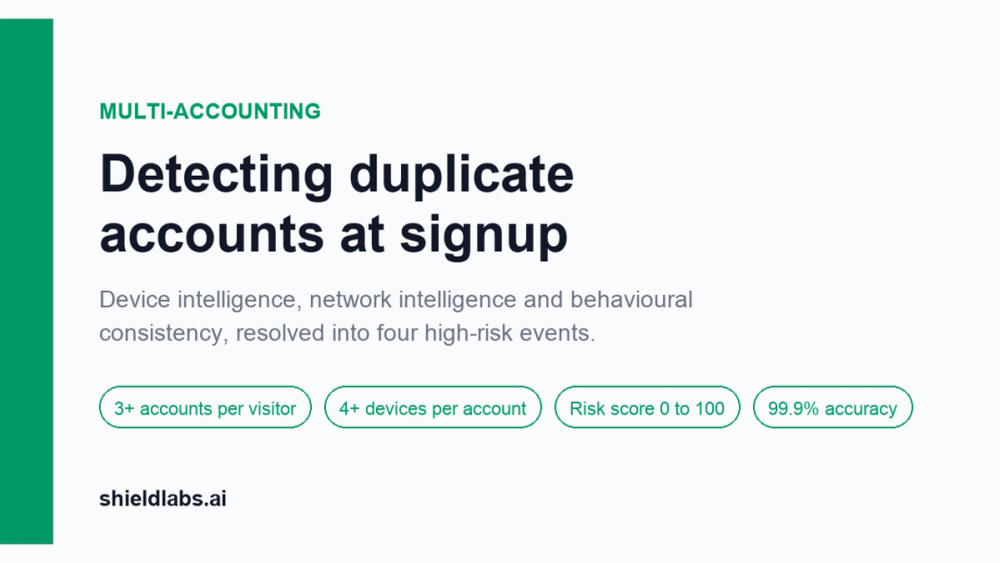
ShieldLabs is fraud detection and prevention with traffic quality scoring for websites and web apps. It identifies risky users under any masking and stops abuse of your product: free-trial cycling, bonus and promo abuse, referral fraud, shared paid accounts, ban evasion and account takeover. A JavaScript snippet collects 300+ device, browser and network risk signals on every visit, cross-checks them, and returns a persistent Visitor ID and Device ID with an explainable risk score from 0 to 100. Identification accuracy and risk signal detection accuracy are both 99.9%.
A bot filter asks whether the current request came from a human. ShieldLabs asks who this person is across sessions, devices and accounts. That is the layer where account abuse actually lives, and most teams have no visibility into it until the discount budget is gone.
Key features
Visitor and user identification. Returning visitors are recognised across sessions, after cleared cookies, in incognito mode and through IP changes. Linked users across accounts, devices and IP addresses are detected automatically.
Device intelligence. Rendering behaviour, screen and font metrics, audio stack, hardware concurrency, platform coherence. Spoofing one attribute is easy, keeping a dozen mutually consistent is not, and inconsistency is itself a signal.
Network intelligence. Datacenter or residential, proxy, VPN, Tor, Apple Private Relay, plus real address discovery when the browser leaks it.
Risk signals. VPN, proxy, Tor, Private Relay, datacenter IP, IP reputation, anti-detect browsers, browser automation, OS tampering, incognito mode and geolocation spoofing, each returned as an individual named signal.
Bot and AI traffic detection. Bots, automated traffic and AI agents, with bad bots separated from good ones.
High-risk events out of the box. Multi-accounting, account sharing, impossible travel and account takeover, each with a Medium or High confidence level. No rules to write, no model to train.
Risk scoring. A score from 0 to 100 for every visitor, user, device and IP address, in three bands: trusted, suspicious, dangerous, with the named signals behind it.
Traffic quality analytics. Every source, channel, referrer and UTM campaign scored for quality, so you see which channels deliver real people.
Use cases
New-account fraud, multi-accounting, account takeover, payment fraud, ad fraud, affiliate fraud, bonus and promo abuse, referral fraud, free-trial abuse, loyalty fraud, ban evasion, Sybil attacks, impossible travel and location spoofing. It also works in the other direction: recognising good returning customers, and turning account sharing into an upgrade conversation.
Typical adopters are SaaS, AI and API products, iGaming, crypto and fintech platforms, marketplaces, ticketing, media and streaming services.
Getting started
Integration takes about five minutes. Drop the snippet on your pages, then read results through the API or receive them on your webhook endpoint. A practical rollout: collect for a week without changing any flow to get a baseline, then gate the expensive action rather than the signup itself. Hold the bonus, delay the payout, require a step up, but let accounts exist.
Pricing and plans
The free plan includes 5,000 one-time identifications, no card required. Starter is 99 per month for 25,000 identifications, Growth 399 for 150,000, Scale 999 for 500,000, with up to 20% off on annual billing. Every tier is self-serve, including the top one: no sales call, no annual contract. Chat and email support are included on every plan, the free one included.
ShieldLabs Inc was founded in 2025 and is based in Sheridan, Wyoming. Documentation is at docs.shieldlabs.ai and the public SDKs are on GitHub under ShieldLabs-ai.