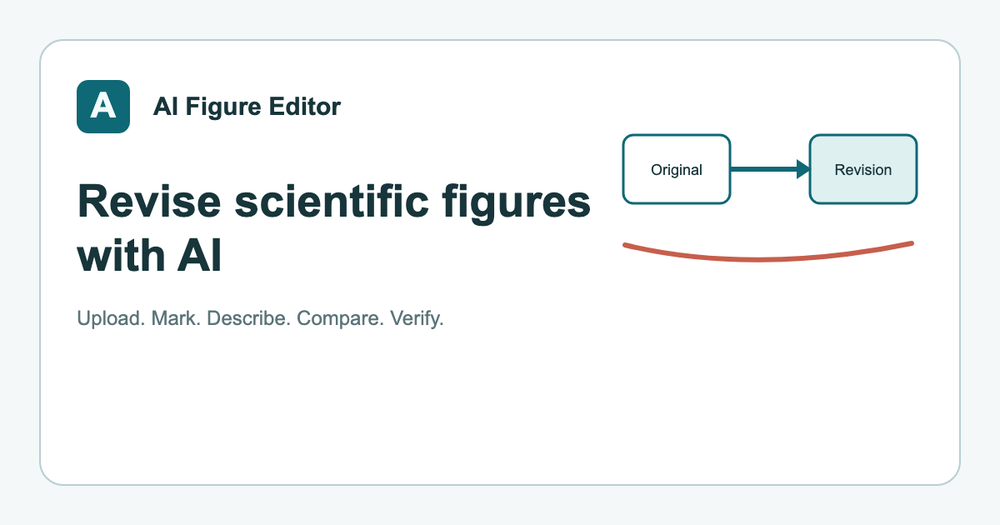
AI Figure Editor is an AI-powered platform designed to assist researchers in revising scientific schematics and figures. It streamlines the process of updating visual content for publications, presentations, and collaborative discussions by allowing users to upload an existing figure, specify desired changes, and generate new versions while preserving the original for comparison.
The platform offers a controlled revision workflow, ensuring that the source figure is always retained, region-specific guidance can be applied, version continuity is maintained, and human verification remains central to the process. This approach helps authors make precise edits without losing the context of their original work.
Key features and capabilities include:
- AI-Assisted Revision: Leverage AI to implement visual changes based on natural language prompts.
- Source Retention: The original figure is always available for comparison alongside any generated revisions, preventing accidental overwrites.
- Region Guidance: Users can mark specific areas of a figure to indicate where changes should be applied, allowing for highly targeted revisions.
- Version Continuity: Continue iterating on a chosen revision, building upon previous changes without losing context.
- Human Verification: Emphasizes that every AI-generated change, especially regarding scientific meaning, terminology, and visual consistency, requires author review and approval.
- Comprehensive Visual Changes: The editor can handle a range of modifications, including:
- Correcting Labels: Renaming modules or shortening captions.
- Rerouting Connections: Untangling arrows, distinguishing activation from inhibition, and preserving directionality.
- Rebuilding Hierarchy: Grouping modules by stage, compartment, or experimental sequence.
- Normalizing Visual Encoding: Applying consistent color, stroke, shape, and spacing.
- Recomposing Panels: Clarifying panel order and aligning elements in multi-part figures.
- Reducing Diagram Density: Improving legibility by separating crowded regions without removing scientific content.
The platform supports various types of scientific figures, including methodology and workflow diagrams, mechanism and pathway illustrations, AI and ML architecture figures, graphical abstracts, and conceptual research diagrams. It is explicitly not designed for altering experimental evidence such as microscopy images, gels, or plotted values, reinforcing the ethical use of AI in scientific illustration.
Users can craft effective revision prompts by clearly defining what needs to "Change," what must "Preserve," and what details require "Verify" after generation. This structured prompting helps reduce ambiguity and ensures the AI understands the author's intent. Furthermore, the tool can translate reviewer or PI feedback into concrete revision plans, making it easier to address critiques systematically.
AI Figure Editor integrates into the research workflow at multiple stages, from initial lab meetings and coauthor reviews to addressing reviewer comments and final submission checks. It provides a traceable record of changes, linking the source, instruction, and result, which is crucial for collaborative projects and maintaining scientific integrity. The ultimate responsibility for scientific accuracy, terminology, and submission readiness remains with the author.