HiAPI Introduction
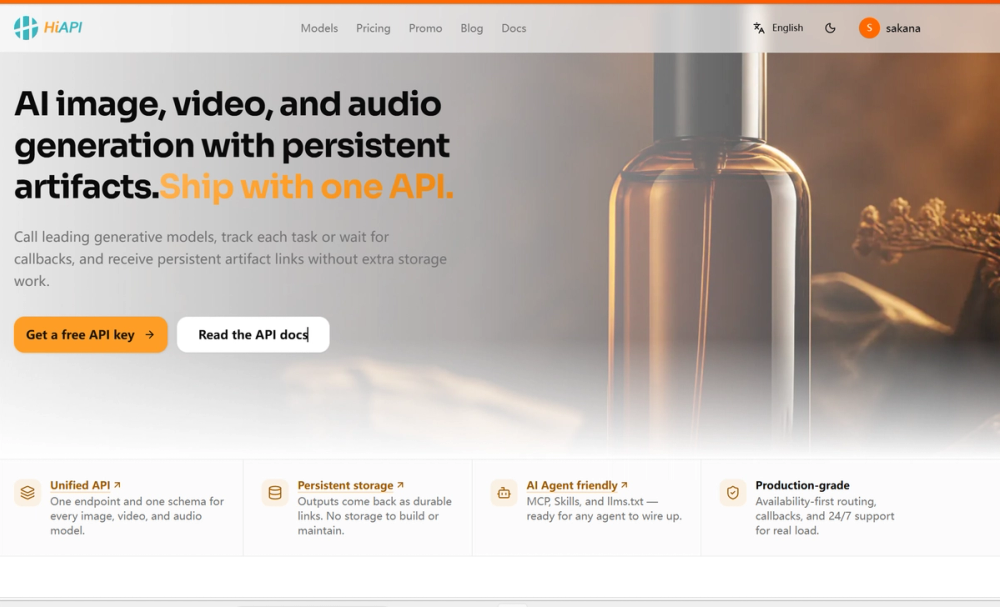
HiAPI is a unified API platform for developers and teams building AI-powered media products. It brings image, video, audio, music, and text generation models into one API surface, one account, and one billing flow. Instead of integrating separate vendors one by one, managing different request formats, API keys, dashboards, and pricing rules, developers can use HiAPI as a single gateway and focus on building their own product.
The main value of HiAPI is reducing fragmentation in generative AI development. Modern AI applications often need more than one model: text-to-image for product visuals, image-to-image for editing, text-to-video for social content, image-to-video for ads, music generation for creative tools, and language models for automation. HiAPI helps teams test and use these models through a consistent workflow, making it easier to compare capabilities, control cost, and ship features faster.
HiAPI is especially useful for creative, commerce, marketing, and automation products. An e-commerce tool can use it for product images, background replacement, campaign posters, and short videos. A marketing platform can generate visuals, videos, and audio assets for different channels. A social media product can offer image generation, image editing, and video creation without building separate integrations for every upstream model provider.
For developers, the core workflow is simple. A request is submitted to POST /v1/tasks with a model name and an input object. HiAPI returns a taskId immediately, while the generation runs asynchronously. The application can then poll GET /v1/tasks/:id during development or use a callback URL in production to receive the final result. This task-based flow is well suited for media generation, where jobs may take seconds or minutes.
HiAPI also helps teams manage production concerns around AI generation. Developers can handle success and failure states consistently, track each job by task ID, use callbacks to reduce polling, and inspect usage through the platform. This is important because building a reliable AI product is not only about calling a model; it also requires job lifecycle management, error handling, billing visibility, and result delivery.
The platform includes a model marketplace with leading generation models from major providers. Developers can browse model pages, check supported parameters, review pricing, and copy request examples. This makes HiAPI useful not only as an API gateway, but also as a discovery layer for choosing the right model for a specific use case.
Pricing is usage-based, which helps teams experiment without large upfront commitments. Builders can use lower-cost settings for drafts and switch to higher-quality tiers for final output. This is valuable for image and video generation, where cost can vary by quality, resolution, duration, and model choice.
HiAPI also reduces vendor lock-in. Since multiple models are available through one interface, teams can choose different models for different workflows based on quality, speed, or cost. If a better model becomes available, teams can adopt it with less integration work because the surrounding task workflow remains familiar.
In short, HiAPI is built for teams that want practical access to modern generative AI models without building a vendor-management system themselves. It combines a unified API, model marketplace, asynchronous task workflow, pay-as-you-go pricing, and production-oriented documentation. For AI image tools, video generation apps, music products, marketing automation, e-commerce creative systems, and multimodal workflows, HiAPI helps teams move from experimentation to production faster.