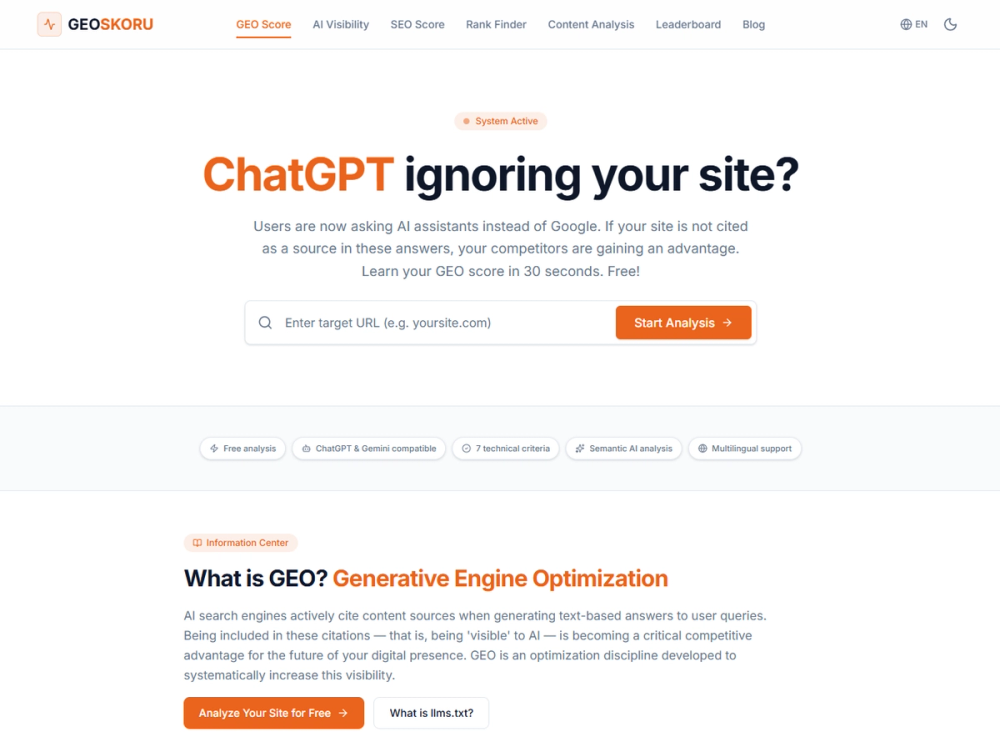
GeoScore is a pioneering platform dedicated to Generative Engine Optimization (GEO), a critical discipline for enhancing website visibility in AI search engines like ChatGPT, Perplexity AI, Google Gemini, and Anthropic Claude. Unlike traditional SEO, which focuses on keyword-based ranking, GEO optimizes content for how artificial intelligence "reads," "understands," and "deems reliable" a website's information. This service offers a free, rapid analysis to determine if your site is being cited as a source by these powerful AI models, providing a comprehensive action plan to improve your AI visibility.
The shift in digital marketing paradigms is profound, with Gartner predicting a 25% decrease in traditional search volume by 2026. This makes AI visibility an indispensable competitive advantage. Sites cited by AI platforms gain significant trustworthiness and authority in users' eyes, translating into improved brand perception, traffic, and conversion rates. GeoScore specifically addresses the unique challenges and opportunities within the Turkish market, where existing international GEO tools often fail to accurately analyze Turkish content signals and readability metrics, offering an early-mover advantage for local content creators.
GeoScore elucidates the fundamental differences between SEO and GEO. While SEO targets platforms like Google and Bing, measuring success by ranking position and focusing on keyword density, page speed, and backlink profiles, GEO targets AI platforms, measuring success by citation and source rate. GEO emphasizes content formats like Q&A, authority, and contextual integrity, with technical requirements including Schema.org, llms.txt, and robots.txt. Trust signals for GEO revolve around E-E-A-T (Expertise, Experience, Authoritativeness, Trustworthiness), author identity, and source quality, often preferring timeless/evergreen content over just fresh content.
The platform details how various AI models evaluate sites:
- ChatGPT / OpenAI: Prioritizes E-E-A-T, structured data, content freshness, and long-form authoritative content, often using the Bing index.
- Perplexity AI: Known for real-time web crawling and transparency, it rewards direct answer formats, Wikipedia-like structured pages, and strong domain authority.
- Google Gemini: Leverages Google's search infrastructure, emphasizing content integrity, multi-modal data structures, and knowledge graph connections alongside traditional SEO signals.
- Anthropic Claude: Primarily uses training data, valuing academic sources, detailed technical content, and consistent, error-free text quality.
GeoScore outlines key GEO strategies to boost AI source visibility by 30-40%. These include integrating statistics and verifiable data, structuring content in a Q&A format with FAQ schema, implementing Schema.org markups (Article, FAQPage, HowTo, Organization), strengthening E-E-A-T signals with author biographies and citation sources, and optimizing llms.txt and robots.txt to allow AI bot access while guiding their content usage. Balancing content recency with evergreen value is also crucial.
GeoScore itself is Turkey's premier GEO analysis platform, employing a two-layered system based on 7 Technical Criteria and 4 Criteria AI Analysis. These criteria include AI Accessibility (GPTBot, ClaudeBot, PerplexityBot permissions), Structured Data quality, E-E-A-T Signals, Answer Block Optimization, Content Recency, Independent Extractability, and Topic Authority. The free analysis provides a detailed report, identifying critical obstacles and offering prioritized improvement suggestions, including a custom llms.txt template. This tool is essential for any digital presence aiming to secure its future visibility in the rapidly evolving landscape of AI-driven search.