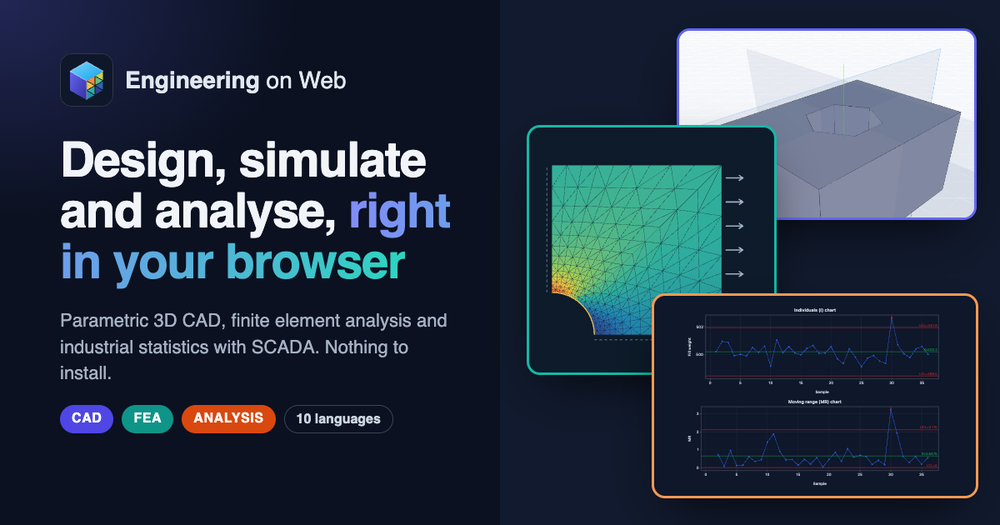
Engineering on Web is a comprehensive suite of engineering tools designed to run entirely within a web browser, eliminating the need for any software installation. This platform provides three core applications: CAD for parametric 3D modeling, FEA for finite element analysis, and Analysis for industrial statistics and SCADA generation. The entire ecosystem is built to be accessible across various operating systems, including Windows, macOS, Linux, and Chromebooks, leveraging modern web technologies like WebAssembly and WebGPU for high-performance computations directly on the user's device.
Engineering on Web CAD focuses on parametric 3D modeling. Users can create detailed sketches with constraints and dimensions, build complex parts step-by-step, assemble components into larger systems, and generate technical drawings. Key features include robust sketching tools, support for parts, assemblies, and technical drawings, and export capabilities for standard formats like STL, STEP, IGES, and DXF. This makes it suitable for designers and engineers needing to conceptualize and detail mechanical components.
Engineering on Web FEA provides a powerful finite element simulation environment. It allows engineers to generate meshes from geometries, select various physics (structural, thermal, fluid, electromagnetism), and solve complex problems with live convergence graphs. The tool supports coupled physics, 2D and 3D analyses, and utilizes WebGPU acceleration with a CPU fallback, ensuring broad compatibility and efficient computation. This is ideal for verifying designs, predicting performance under different conditions, and optimizing material usage.
Engineering on Web Analysis is tailored for industrial statistics and SCADA applications. It enables users to analyze process data using Six Sigma tools, perform calculations, generate publication-ready graphs, and create SCADA systems for factory floors. Specific features include control charts, capability analysis, design of experiments (DOE), a matrix console, and SCADA exportable to Windows, macOS, and Linux. This tool is crucial for quality control, process optimization, and real-time monitoring in manufacturing environments.
Integrated Workflow and Accessibility: A significant advantage of Engineering on Web is the seamless integration between its tools. Users can design a part in CAD, export it in STL or STEP format, import it directly into FEA for simulation, and then use Analysis to monitor production and quality. The platform boasts an intuitive interface available in ten languages, including Portuguese, English, Spanish, French, German, Chinese, Japanese, Russian, Hindi, and Arabic, making it globally accessible. By performing all computations client-side, it ensures data privacy and responsiveness, making it a versatile and powerful solution for modern engineering challenges.