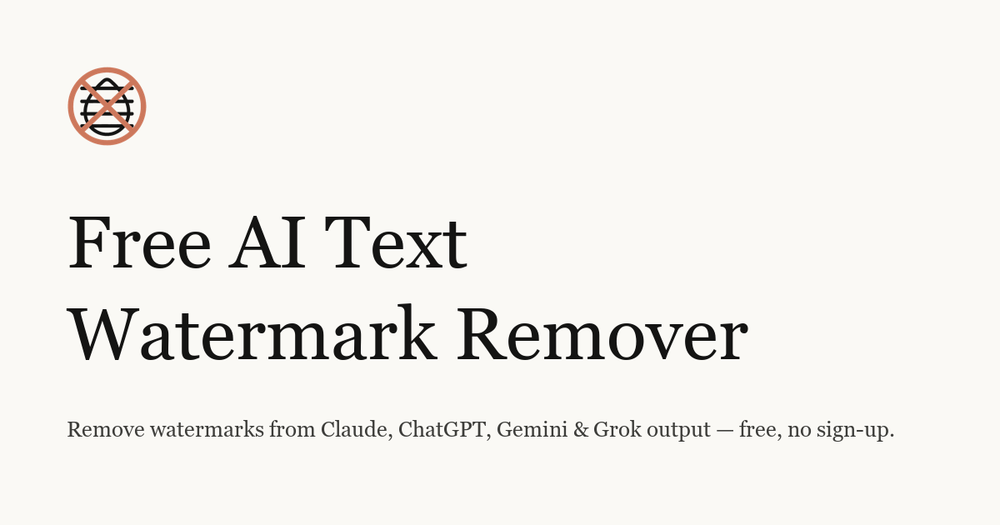
AI Text Watermark Remover is a comprehensive online tool designed to detect and remove various types of AI-generated text watermarks from content produced by large language models such as Claude, ChatGPT, Gemini, and Grok. The service operates with a strong emphasis on privacy, offering both instant, browser-based cleaning and a more advanced rewriting mechanism without requiring sign-up or storing user data.
The tool addresses two primary categories of AI text watermarks:
Quick Clean: Character Sweep for Hidden Watermarks
This feature targets watermarks embedded as invisible Unicode characters, commonly found in output from tools like ChatGPT. Quick Clean performs an instant, 100% local scan within your browser, identifying and stripping over 34 different types of hidden characters. These include:
- Zero-Width Space (U+200B): A classic invisible AI watermark character.
- Narrow No-Break Space (U+202F): Often seen in ChatGPT output, appearing as a space in some fonts, invisible in others.
- Byte Order Mark / ZWNBSP (U+FEFF): A file-format artifact that can persist as an invisible character after copy-paste.
- Soft Hyphen (U+00AD): Renders only at line breaks, otherwise invisible.
- Word Joiner (U+2060): Prevents line breaks without displaying a glyph.
- Directional Marks (U+200E / U+200F): Left-to-Right and Right-to-Left marks that can hide within text.
- Bidi Control Characters (U+202A–U+202E): Embedding and override controls that can even reorder text display.
- Tag Characters (U+E0000–U+E007F): A plane of 128 invisible tags capable of encoding hidden payloads.
- Various Space Variants (U+2000–U+200A, U+3000, U+205F, U+1680): Eleven space variants that mimic ordinary whitespace, plus ideographic, math, and Ogham spaces.
Quick Clean is entirely free and offers unlimited usage, as it processes text directly on the user's device, ensuring no data leaves the browser.
Deep Rewrite: Paraphrasing for Statistical Watermarks
For advanced statistical watermarks, such as those implemented by Anthropic's Claude, a different approach is required. Claude's watermark is not based on hidden characters but on subtle biases in word choice, creating a verifiable pattern in the sequence of words. Deleting characters has no effect on this type of watermark.
Deep Rewrite addresses this by sending the text through a large language model (LLM) API to paraphrase it. This process aims to break the original statistical pattern of word choices, thereby weakening the watermark. It's important to note that Deep Rewrite is a "best-effort" solution; while it aims to disrupt the watermark, no tool can guarantee complete removal against proprietary, non-public detectors like Anthropic's.
Deep Rewrite is free with a daily limit of 10 rewrites per device, which can be extended by sharing the tool. The service ensures privacy by processing text through the API exactly once, without storing input or output in any database or logs.
Use Cases and Privacy
This tool is ideal for users who need to ensure their AI-generated text is free from hidden markers or statistical patterns that could indicate its origin. It's particularly useful for content creators, students, and professionals who want to maintain control over their text's integrity and avoid unintended detection by AI content checkers. The commitment to privacy means users can process sensitive information without concern for data storage or tracking.
The tool explicitly states it is not affiliated with Anthropic or OpenAI and emphasizes user responsibility for complying with academic integrity rules, employment agreements, and platform terms of service.