Reviewed and fact-checked: August 31, 2026. Disclosure: This independent review is based on current first-party product, pricing, privacy, and legal documentation. Product capabilities and prices can change. We may earn an affiliate commission on qualifying purchases at no additional cost to you.
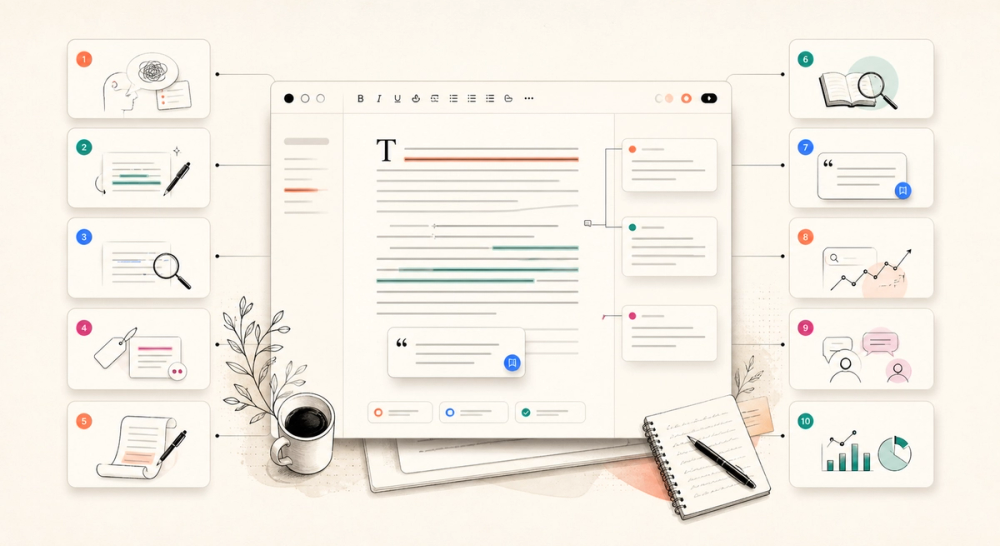
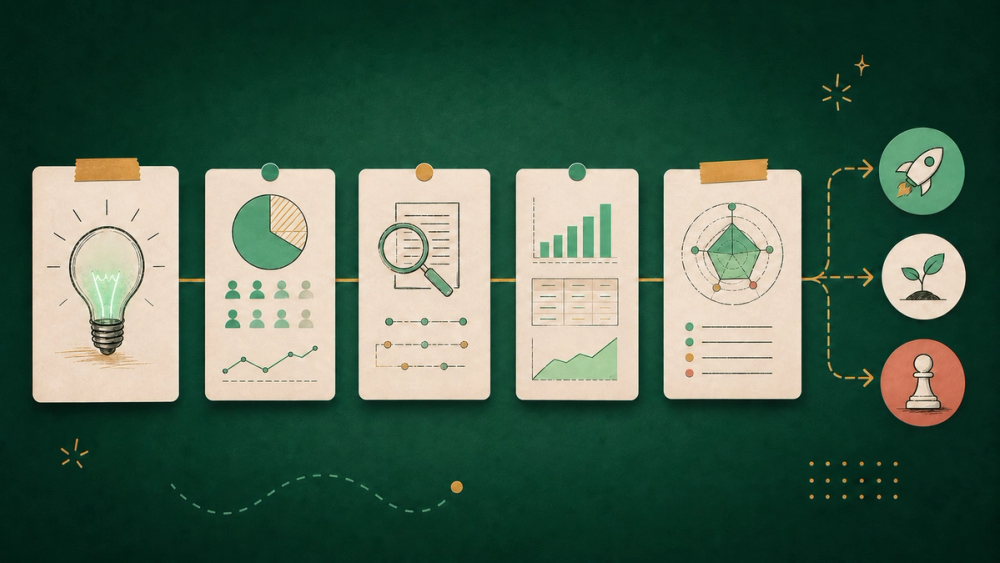
EntreDash positions itself as a personal "innovation operating system" for moving from an early idea through market validation, invention strategy, product planning, and business preparation. According to the company's homepage, its workflow orchestrates 10+ purpose-built AI agents across three customer-facing specialist perspectives: product strategy, IP and patent analysis, and financial diligence. The platform combines those perspectives with cited public-record research and plain-language recommendations, including Go, Pivot, or Stop outcomes. These outcomes are preliminary AI-generated recommendations—not proof of demand, patentability, non-infringement, or commercial success.
In this detailed review, we examine how EntreDash works, analyze its prior-art search and validation capabilities, evaluate its pricing tiers, and compare it against generic AI tools, conventional validation software, and traditional legal pathways.
Quick Summary & Editorial Verdict
| Dimension | Assessment & Key Details |
|---|---|
| Core Purpose | Early-stage market validation, prior-art screening, product development, and patent-preparation workflows. |
| Primary Features | EntreDash Spark, 10+ purpose-built agents across three specialist perspectives, cited strategy deliverables, three Education Center curricula, Design Workspace tools, and a beta directory of 50,000+ USPTO-registered attorneys and agents. |
| Data Sources | EntreDash says it searches 100+ patent-office collections through Espacenet, eight office systems directly, and federal, academic, and live-web sources. |
| Pricing Model | Starter ($0), Standard ($12.99 annual-rate or $19.99 monthly), Plus ($49.99 annual-rate or $74.99 monthly), Pro ($119.99 annual-rate or $179.99 monthly), plus pay-as-you-go and patent-preparation purchases. |
| Best For | Inventors and early founders who want structured product, IP, and financial research before consulting specialists. |
| Important Limits | Not legal advice, not an exhaustive professional patent search, not a freedom-to-operate opinion, and not a replacement for customer or technical validation. |
| Overall Verdict | A strong fit for structured pre-attorney preparation when users treat citations and verdicts as research inputs rather than legal or commercial clearance. |
What is EntreDash? (The Real Problem It Solves)
Professional IP Work Can Be Expensive: A USPTO burden estimate uses $447 per hour as the 2023 AIPLA average billing rate for IP work across all firms. That is an administrative cost assumption—not a fixed patent-attorney fee or patent-search quote. Actual rates and project costs vary widely by jurisdiction, practitioner, technology, and scope.
- The Human Advisory Route is Costly: According to the Report of the Economic Survey by the American Intellectual Property Law Association (AIPLA), intellectual property attorneys typically bill $250 to $600+ per hour, with the USPTO citing an industry average of $447/hr in the Federal Register. Furthermore, a professional patentability search conducted by a law firm commonly costs $1,000 to $3,000 (AIPLA reports a median around $2,000). Spending thousands of dollars before verifying basic customer interest or technical feasibility is a major barrier for everyday innovators.
- General-Purpose AI Is a Different Category: ChatGPT and Claude now offer web search and research features, so it is inaccurate to describe them as relying only on training memory. However, neither provider publicly advertises EntreDash's purpose-built combination of structured invention intake, cited multi-registry patent research, design decomposition, and practitioner matching.
- Business-Planning Tools Emphasize Different Workflows: IdeaBuddy, VenturusAI, and LEANSpark support broad categories of businesses—not only digital SaaS. Their public product pages emphasize business planning, strategic reports, Lean Canvas, customer evidence, experiments, or financial modeling; the pages reviewed do not advertise EntreDash-style patent prior-art search or invention-design workflows.
EntreDash bridges this gap. As EntreDash describes its platform, it orchestrates multiple specialized AI models—leveraging Claude for deep reasoning and live research, Gemini for fast extraction, and GPT for structured synthesis—against live public registries. The goal is not to replace patent attorneys, but to provide an affordable, data-backed first read so founders enter their attorney consultations fully prepared.
Core Features Breakdown
1. EntreDash Spark: Turning Frustrations into Structured Concepts
Not every venture begins with a polished pitch deck. EntreDash Spark is an ideation engine designed for the earliest stage of thinking: when you observe a daily annoyance or inefficient process but have not yet formulated a commercial solution.
Users describe a specific problem or friction point in plain English. Spark analyzes the underlying market need, identifies potential mechanical or digital solution pathways, and outlines several distinct business directions in minutes. This feature helps founders transition from vague frustration to a testable concept without requiring prior business modeling experience.
2. Virtual AI Advisory Board & Specialized Strategy Memos
Rather than asking one general-purpose model to evaluate every angle, EntreDash says it orchestrates 10+ purpose-built agents and routes work among Claude, Gemini, GPT, and other available models. Users encounter three principal specialist perspectives:
- Product Strategy: Examines customer need, market sizing, competitive context, and recommended validation steps.
- IP and Patent Analysis: Decomposes potentially claimable elements, searches public prior art, and can produce CPC classifications, keywords, Boolean queries, cited candidates, and preliminary risk signals.
- Financial Diligence: Produces scenario-based business cases covering revenue, costs, EBITDA, unit economics, break-even, and preliminary valuation ranges. Component and material breakdowns belong to the separate Design Workspace.
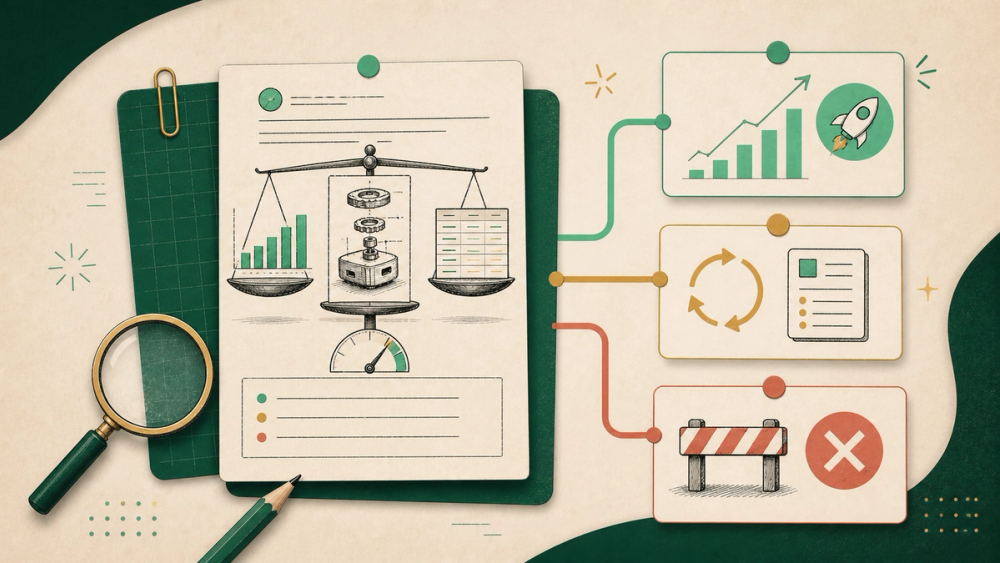
EntreDash produces cited deliverables and a plain-language outcome. The exact output depends on the workflow and plan: Starter includes a combined product, IP, and financial verdict, while Standard and higher include all three specialist memos in full. Go, Pivot, and Stop should be interpreted as recommendations:
- Go: EntreDash's preliminary recommendation that the available evidence supports continued investigation. It does not verify novelty, patentability, demand, non-infringement, or freedom to operate.
- Pivot: The analysis found material issues or unanswered questions that may be addressable by changing the mechanism, customer, positioning, or business assumptions.
- Stop: The analysis found concerns serious enough to pause. Review the cited evidence and reasoning; do not assume the result proves an active patent conflict or a definitive commercial outcome.
3. Live Prior-Art Research & Multi-Registry Integration
A major differentiator for EntreDash is its reliance on live external data queries rather than static training memory. According to EntreDash's platform documentation, the system searches live data across:
- Patents and IP: EntreDash's methodology says it searches 100+ national-office collections through Espacenet and searches eight office systems directly: the United States, EPO, WIPO, China, Japan, Canada, Singapore, and Korea. It also lists USPTO, Google Patents, Espacenet, WIPO, PatentsView, and TESS among its patent and trademark sources.
- Economic & Industry Benchmarks: U.S. Census Bureau, SEC EDGAR filings, the Bureau of Labor Statistics (BLS), and Federal Reserve Economic Data (FRED).
- Academic & Scientific Literature: OpenAlex, PubMed, and CrossRef.
EntreDash says its reports include an audit trail and checkable citations. Users should open the underlying records and verify important details directly; citations do not make an automated search exhaustive or legally conclusive.
4. Gamified IP & Entrepreneurship Education Center
EntreDash says its Education Center contains three curricula and 16 learning paths covering intellectual property, new product development, and commercialization.
- Intellectual Property: Educational material about protecting and documenting inventions.
- New Product Development: Educational material about turning a validated concept into a buildable product.
- Commercialization: Educational material about business preparation, licensing, selling, and scaling.
The expanded pricing comparison lists spaced-repetition study cards plus streaks, levels, and badges for Standard and higher. The public pricing page is internally inconsistent about Starter access: its summary says every plan includes the full Education Center, while the expanded table marks full access unavailable on Starter.
5. Downstream Execution Tools & Practitioner Marketplace
EntreDash supports the invention process beyond the initial memo:
- Design Decomposition: A structured digital canvas where inventors decompose physical products into discrete components, detailing materials, functions, and physical connections.
- Design-to-Drawing Preparation: EntreDash describes the design breakdown as a foundation for later prototyping and patent drawings; the public pages reviewed do not clearly promise automatic numbered patent-style figure generation as a currently available feature.
- USPTO Practitioner Marketplace: A beta directory of more than 50,000 USPTO-registered patent attorneys and agents. The official USPTO directory showed 53,606 active practitioners when checked on August 31, 2026. Profiles can be filtered using location, practice-focus, technical-specialty, and accessibility signals. EntreDash does not vet or endorse practitioners, and users must verify credentials, fit, fees, conflicts, and availability.
- Prototyping Marketplace: EntreDash presents a prototyping marketplace as part of its broader product journey. Its public pages do not substantiate a vetted supplier directory or guarantee specific fabrication categories.
Step-by-Step Walkthrough: Using EntreDash
Here is how a founder moves from a raw concept to an actionable, data-backed strategy within EntreDash:
- Ideation & Capture: Input your rough product concept or run an EntreDash Spark session to structure a daily problem into distinct solution mechanisms. All ideas are version-controlled in your private workspace.
- Launch the AI Advisory Session: Select the concept and initiate a session. The platform prompts you for essential context—target audience, core functionality, intended materials, and business assumptions.
- Receive the Deliverable and Outcome: EntreDash advertises an initial advisory-board result in under 15 minutes. Its student FAQ says a full strategy session usually takes 15–25 minutes, followed by approximately 2–5 minutes for memo compilation, so end-to-end time can be longer.
- Decompose and Refine the Design: Where applicable, use the Design Workspace to break the concept into components, functions, candidate materials, and connections. Treat cited prior art as research input, not as clearance to manufacture, sell, or file.
- Export and Seek Professional Advice: Standard and higher plans include downloadable memo PDFs. EntreDash's Privacy Policy also says users can export ideas and memos as JSON. When formal drafting, filing, patentability, or freedom-to-operate analysis is needed, consult a qualified registered patent practitioner.
Pricing Plans & Cost Comparison
EntreDash offers Starter, monthly or annual subscriptions, pay-as-you-go purchases, and credit packs. Prices and entitlements below were checked on August 31, 2026; verify the current pricing and checkout pages before purchasing.
Subscription Plans Matrix
| Feature | Starter | Standard | Plus | Pro |
|---|---|---|---|---|
| Annual Billing | Free | $12.99/mo ($155.88 billed yearly) | $49.99/mo ($599.88 billed yearly) | $119.99/mo ($1,439.88 billed yearly) |
| Monthly Billing | Free | $19.99/mo | $74.99/mo | $179.99/mo |
| Strategy Sessions / Memos | 1 / month | 3 / month | 12 / month | 30 / month |
| Spark Ideation Runs | 2 / month (first 3 free at signup) | 5 / month | 10 / month | 20 / month |
| Specialist Output | Combined product, IP, and financial verdict | All three specialist memos in full | Same as Standard | Same as Plus |
| PDF Download | Not included in comparison table | Included | Included | Included |
| Education Center | Official pricing copy conflicts with its expanded table | Full access | Full access | Full access |
| Study Cards, Streaks, Levels & Badges | Not included in comparison table | Included | Included | Included |
| Build Tools | — | — | 4 ideas / month | 10 ideas / month |
| Priority Memo Compilation | — | — | — | Included |
| Early Access to New Modules | — | — | — | Included |
Pay-As-You-Go & One-Off Purchases
For users who prefer not to maintain an ongoing monthly subscription:
- Spark 10-Pack (
SPK·10): $4.99 for 10 ideation runs. - Single Strategy Session (
STR·01): $9.99 for one complete strategy session and memo. - Advisory Set of Three (
ADV·03): $14.99 for all three specialist memos on one idea ($5.00 each). - Build Tools Pack (
BLD·02): $14.99 to unlock customer discovery and canvas tools for 2 ideas. - Credit Packs: 36 credits ($179.99), 144 credits ($699.99), and 360 credits ($1,449.99). Session credits do not expire, but bundled perks such as Spark packs, build tools, and early access expire one year after purchase.
Deep-Dive Legal Add-ons: Contextualizing the $499.99 Search
EntreDash offers two specialized patent search add-ons that sit above standard monthly plans:
- Search Strategy ($14.99 per invention): Produces a classification and keyword search plan tailored to the invention.
- Prior Art and Novelty Search ($499.99 per invention): Provides an automated prior-art landscape and novelty read across available public patent databases. EntreDash's Terms state that the search is not exhaustive, excludes unpublished pending applications, and is not a professional search or freedom-to-operate opinion.
Note
How to interpret the $499.99 price: A USPTO burden estimate cites the 2023 AIPLA average billing rate for IP work across all firms as $447 per hour, but that is not a patent-search quote and actual practitioner fees vary. EntreDash's automated search can serve as an intermediate screening step; it should not be described as a complete substitute for a professional search or legal analysis.
Best Practices for Interpreting Results
To maximize the value of your EntreDash reports, consider the following best practices:
- Treat Verdicts as Decision Filters, Not Proof: A Go result means EntreDash's preliminary analysis supports further investigation. It does not establish novelty, patentability, demand, non-infringement, freedom to operate, or future sales. Apply the same caution to Pivot and Stop results.
- Review Cited Records Directly: Open the cited patent and market records and check dates, status, claims, assumptions, and context. Ask a registered patent practitioner to interpret claim scope, patentability, or freedom-to-operate implications.
- Use Memos to Prepare for Professional Advice: A structured memo and design breakdown may help you explain the concept and questions more efficiently during an attorney consultation. Actual time or fee savings depend on the practitioner, technology, and scope of work.
Comparison: EntreDash vs. Alternative Options
| Evaluation Factor | EntreDash | ChatGPT / Claude | IdeaBuddy / VenturusAI / LEANSpark | Patent Attorneys & Agents |
|---|---|---|---|---|
| Primary Positioning | Product, IP, and financial workflows for early inventors and founders | General-purpose AI assistants with web search and research features | Business planning, strategic analysis, Lean Canvas, customer evidence, experiments, and financial modeling | Professional patent preparation, prosecution, search, and legal advice within the engagement scope |
| Patent Workflow | Vendor-stated cited public-record research across patent sources; non-exhaustive and not FTO | No publicly advertised purpose-built multi-registry invention workflow comparable to EntreDash | Public pages reviewed do not advertise patent prior-art search | Scope varies; qualified practitioners can provide professional analysis and advice |
| Physical-Product Support | Design decomposition and product-development workflow | Broad reasoning and research, but not a dedicated invention-design workflow | Not SaaS-only; LEANSpark explicitly supports physical products, but these tools do not advertise EntreDash-style invention design | Depends on the practitioner's technical field and engagement |
| Structure | 10+ purpose-built agents across three customer-facing specialist perspectives | General-purpose models, tools, projects, and research modes | Vendor-specific planning and validation workflows | Human professional services defined by the engagement |
| Pricing | Free Starter; subscriptions up to $179.99/mo, plus one-off purchases | Free tiers and multiple paid plans; both currently list a $20/mo individual plan | Varies substantially by vendor and tier; check current official plan pages | Fees vary by practitioner, jurisdiction, technology, and scope; a USPTO estimate uses $447/hr as an AIPLA average for IP work across all firms |
| Data-Use Position | Vendor says confidential idea content is not used to train AI models | Personal consumer plans provide opt-out model-training controls; business and API defaults differ | Varies by vendor and plan | Communications may be privileged only when the legal requirements for privilege are met |
| Timing | Vendor advertises an initial result under 15 minutes; full-session guidance can be longer | Often interactive, but research time varies | Varies by product and report type | Varies by scope, practitioner, and availability |
Platform Limitations: What EntreDash Cannot Do
An objective review must highlight where automated AI tooling reaches its boundaries:
- Cannot Provide Legal Advice, Patentability Decisions, or Freedom-to-Operate Opinions: EntreDash does not create an attorney-client relationship. Its automated searches can be incomplete or inaccurate and do not replace a professional search, legal analysis, or counsel.
- Complex Fields Still Need Specialists: EntreDash says software, chemistry, biotech, and complex commercially licensed inventions are harder to handle without professional help. The site does not claim to perform wet-lab, clinical, chemical, or regulatory validation.
- Does Not Replace Real-World Customer Discovery: While EntreDash can generate interview scripts and financial projections, founders must still engage real prospective customers to validate willingness to pay.
Who Should Use EntreDash (and Who Should Skip It)
Ideal For:
- Independent Inventors & Hardware Developers: Creators developing physical products who need rapid prior-art checks and component decomposition before building prototypes.
- Solopreneurs & Bootstrapped Founders: Builders who require multi-dimensional market, financial, and IP sanity checks without burning early capital on consultants.
- Student Innovators & University Teams: Engineering and business students who want a structured framework to learn IP fundamentals and pressure-test capstone concepts.
- Founders Preparing for Patent Filings: Inventors who want to gather prior-art documentation to make attorney consultations more efficient.
Who Should Skip It:
- Teams in Biotech, Chemistry, Pharma, or Other Complex Fields: Use EntreDash only as preliminary educational or strategic input and involve qualified technical, regulatory, and patent professionals early.
- Entrepreneurs in Active Patent Disputes: Anyone facing patent litigation or licensing disputes requiring immediate, formal legal representation.
- Passive Idea Collectors: Users expecting an automated "hands-off" business without physical prototyping, testing, and sales execution.
Data Privacy, IP Confidentiality & Legal Disclaimer
Confidentiality matters when evaluating a pre-patent idea. Data-use settings vary among AI products and plans, so users should review the applicable privacy controls and contract terms before submitting sensitive information.
Vendor Confidentiality Stance
According to EntreDash's Terms of Service and Privacy Policy:
- No AI Model Training on User Submissions: Concepts, descriptions, and invention logs entered into EntreDash are not used to train or fine-tune underlying public or proprietary AI models.
- Contractual Confidentiality: EntreDash's Terms of Use include confidentiality provisions governing submitted proprietary concepts.
- Ownership, Export, and Deletion: Users retain ownership of submitted ideas and generated deliverables. EntreDash says users can delete individual ideas or their account; deleted content is removed promptly and purged from backups within the platform's standard retention window.
Important
Mandatory Legal & IP Disclaimer
EntreDash is an automated software platform providing educational frameworks, strategic analysis, and preliminary prior-art screening. It is not a law firm, does not provide legal advice, and does not establish an attorney-client relationship. Its searches are not exhaustive, may be incomplete or inaccurate, exclude unpublished pending applications, do not decide patentability, and are not freedom-to-operate opinions. Consult a qualified registered patent practitioner before filing an application or making decisions that depend on claim scope, patentability, infringement, or legal rights.
Frequently Asked Questions (FAQ)
1. Does EntreDash offer a genuinely free plan?
Yes. EntreDash provides a Free Starter Plan that includes 1 guided strategy session and memo per month, 2 Spark ideation runs per month (with 3 free Sparks upon initial sign up), full in-app access to strategy verdicts, and unlimited idea capture in your private workspace. No credit card is required to register.
2. Can I use EntreDash without a recurring monthly subscription?
Yes. EntreDash offers pay-as-you-go purchases, including a Spark 10-Pack for $4.99, a single Strategy Session & Memo for $9.99, an Advisory Set of Three memos for $14.99, or non-expiring credit packs ranging from 36 to 360 credits.
3. Does EntreDash replace a licensed patent attorney?
No. EntreDash is designed to help users organize preliminary questions and evidence before consulting a patent practitioner. A structured memo may make an initial conversation more efficient, but actual research, drafting, filing, and legal-analysis time depends on the practitioner and matter.
4. Is my proprietary idea used to train AI models?
According to EntreDash's Privacy Policy, Terms, and Security page, confidential idea content is not used to train AI models. The company says its AI providers process content to generate requested outputs under enterprise API terms that prohibit training on those inputs.
5. How does EntreDash compare to tools like IdeaBuddy or LeanStack?
IdeaBuddy focuses on guided business planning, financial projections, and questionnaire-based validation. VenturusAI emphasizes strategic reports such as SWOT, PESTEL, competitive, market, and financial analysis. LEANSpark focuses on Lean Canvas, customer evidence, experiments, and continuous-validation coaching, and explicitly supports physical products as well as SaaS and services. The public pages reviewed for these products do not advertise EntreDash-style patent prior-art search or invention-design workflows.
6. Where does EntreDash pull its market and prior-art data from?
According to EntreDash's methodology, the platform searches 100+ national patent-office collections through Espacenet and eight office systems directly. It lists USPTO, Google Patents, Espacenet, WIPO, PatentsView, and TESS for patent/IP research; U.S. Census, SEC EDGAR, BLS, and FRED for market and economic data; and OpenAlex, PubMed, CrossRef, and the live web for scientific and current information.
7. What should I do if my idea receives a "Stop" verdict?
Treat a Stop result as a signal that EntreDash found concerns serious enough to pause and investigate. Review the cited evidence and assumptions, consider whether the idea can be changed, and consult appropriate professionals where legal or technical conclusions matter. A Stop result does not itself prove an active patent conflict or that the concept is legally or commercially impossible.